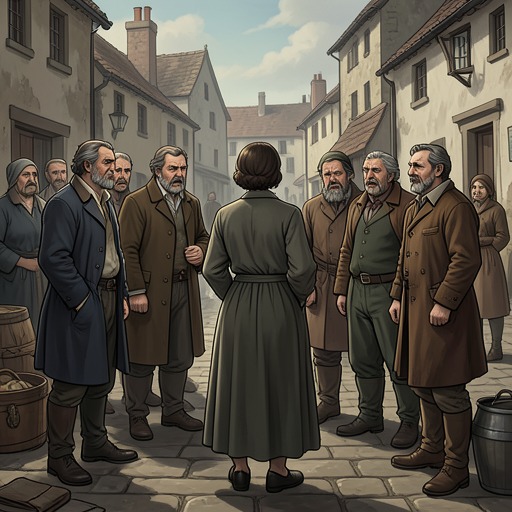
Rumors about Helen at the Markham gathering
The Tenant of Wildfell HallRumors about Helen at the Markham gathering is a defining scene in which private uncertainty becomes public accusation. At one of the Markham family’s quiet parties, Eliza Millward questions Helen Graham’s marital past and implies that her child’s resemblance may point to Mr. Lawrence. Gilbert Markham objects, while Jane Wilson challenges the insinuation and condemns its circulation. The exchange exposes the gendered force of parish gossip: Helen’s reserve is treated as evidence against her, even though the speakers lack the knowledge needed to substantiate their claims.
The gathering and its undercurrent
A few days after Gilbert had been thinking about the foundations of the rumors surrounding Helen and how they might be disproved, his family held another of its quiet parties for friends and neighbors. Helen was among those invited. Gilbert had feared that without her the evening would be intolerably dull; her arrival, he says, brought the house to life. Yet her presence did not simply quiet curiosity. It gave the assembled company a new occasion to inspect the relationship between a secluded woman and the people around her.
Mr. Lawrence, the young squire whose family had once occupied Wildfell Hall before moving to a more modern house in a neighboring parish, was also present. He seated himself apart from Helen, between Gilbert’s mother and Rose. Eliza seized on the distance as a performance, whispering to Gilbert that Helen and Mr. Lawrence seemed like perfect strangers. His reply, that they were almost so, did not satisfy her curiosity; instead, the apparent absence of intimacy became another detail to interpret.
From uncertainty to insinuation
When the conversation turned to Helen, Eliza asked Gilbert whether he knew what he had heard or imagined against her. He said he might be able to set her right if she would tell him what the charge was. Rather than produce evidence, Eliza asked whether Helen had ever had a husband. She then drew attention to the child, asking whether Gilbert had noticed a striking likeness between him and someone whose name she did not initially say. The insinuation gathered force through questions and ellipses, not through proof.
Jane Wilson pressed Eliza to identify whom she meant. She then rejected the premise: in her view, no one present resembled the child except Helen herself. She presumed Eliza was alluding to Mr. Lawrence, but said that suspicion was misplaced. Even if Mr. Lawrence had some particular connection with Helen, Jane argued, no one had a right to assert it; in public he had shown only the propriety of a bow, and had seemed surprised and annoyed to find Helen at the gathering. The scene therefore sets an observable fact—the two were sitting apart—against the speculative story Eliza tries to build from it.
Rebuke and the witness's own suspicion
Gilbert was indignant at Eliza’s question about whether Helen had a husband, but initially could not trust himself to answer. Jane’s defense gave him a way to intervene. He interrupted Eliza and insisted that the company had heard enough on the subject; if they could only speak in order to slander their betters, they should hold their tongues. Fergus, seated beside Eliza, had already encouraged Jane with an exuberant demand that she leave no stone standing. The exchange makes the party’s divisions visible: some treat the rumor as entertainment, while others recognize that repeating it does harm even when its details are uncertain.
The defense does not leave Gilbert’s own judgment untouched. He recalls having entertained, even briefly, the same detestable suspicion about Helen and Mr. Lawrence. He then rejects it by recalling his conversations with Helen and his conviction that her intellect and moral character surpassed those of her detractors. His admission complicates the apparent distinction between malicious gossip and loyal resistance: affection and familiarity may help him defend her, but they have not made him immune to the rumor’s insinuating logic.
What the scene knows—and withholds
The party’s accusations are not a revelation of Helen’s history. They are an early, incomplete interpretation of a woman whose identity and past remain concealed from Gilbert and the neighborhood. The narrative later changes the reader’s access to that history when Helen, in great agitation, gives Gilbert a thick manuscript, asks him to read it, and charges him to tell no living person what it contains. Gilbert presents the document to Halford within his own account, making the embedded manuscript a formal counterweight to the public talk: gossip circulates fragments, while Helen’s written testimony supplies context she has chosen to entrust to one reader.
That shift in form also marks the limits of the gathering as evidence. The party establishes what people suspect and how they behave toward Helen; it does not establish the truth of their suggestions. Gilbert’s retrospective narration lets the reader see both the harm of the insinuation and the narrator’s earlier uncertainty, while the manuscript promises a fuller account without making the neighbors’ conjectures reliable. The episode’s importance lies in this gap between a woman’s unknown history and the community’s readiness to fill it in: silence becomes a surface onto which others project a scandal, and a public rebuke can stop one conversation without yet undoing the larger machinery of rumor.